Co-directeur | Co-supervisor : Paul George (ULaval)
Mon projet de maîtrise porte sur les bioaérosols, c’est-à-dire des particules vivantes ou issues d’organismes vivants présentes dans l’air. Ceux-ci peuvent influencer la santé respiratoire, en contribuant par exemple au développement de l’asthme ou des allergies, mais aussi en modulant le système immunitaire. Ils jouent également un rôle sur les écosystèmes, d’où l’importance de déterminer quels microorganismes les composent. De plus, l’effet de l’utilisation du territoire et de l’urbanisation sur l’aérobiome est encore peu connu dans la littérature. Dans ce projet, j’étudie la composition microbienne des bioaérosols dans l’air de Scarborough (ON), Chicoutimi (QC) et Resolute (NU) durant la saison estivale. Les échantillons sont collectés à l’aide de deux types d’échantillonneurs, l’un sec et l’autre humide, qui permettent de concentrer les bioaérosols. L’extraction d’ADN, suivie d’une PCR quantitative et d’un séquençage par amplicons d’un marqueur universel bactérien et un marqueur universel fongique, serviront à atteindre l’objectif principal du projet.
My master’s project focuses on bioaerosols, living particles or derived from living organisms that are present in the air. These can influence respiratory health, for example by contributing to the development of asthma or allergies, but also by modulating the immune system. They also play a role in ecosystems, which makes it important to determine which microorganisms they are composed of. Moreover, the effect of land use and urbanization on the aerobiome is still poorly understood in the literature. In this project, I study the microbial composition of bioaerosols in the air of Scarborough (ON), Chicoutimi (QC), and Resolute (NU) during the summer season. Samples are collected using two types of samplers, one dry and one wet, which allow bioaerosols to be concentrated. DNA extraction, followed by quantitative PCR and amplicon sequencing of a universal bacterial marker and a universal fungal marker, will be used to achieve the main objective of the project.
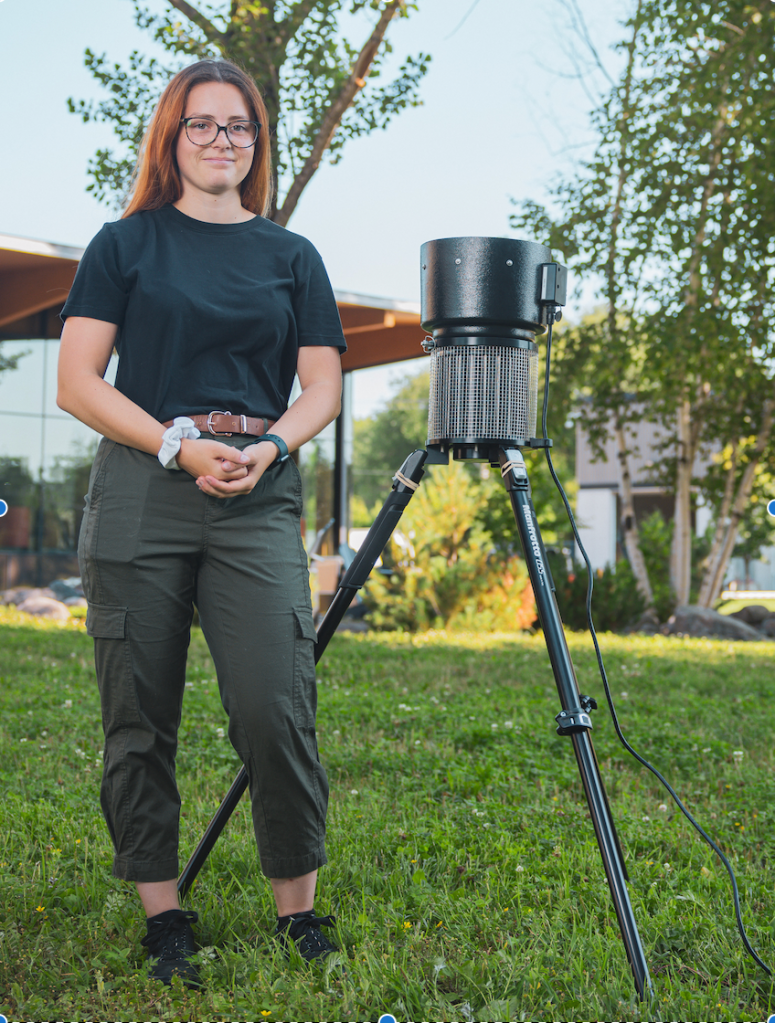
Photo credit Samuel Taillon (UQAC)
 patrimoine microbien | microbial heritage lab